
The best air hose reel for garage use is the one that matches how you actually work: your compressor size, how far you move around the bay, and whether you want a reel that you pull by hand or one that retracts itself. Buy the wrong style and you get the usual headache, hose kinks, weak airflow, or a reel that “fights you” every time you rewind.
This guide keeps it practical, what to look for in 2026, what matters for most U.S. home garages, and which specs are marketing fluff. I’ll also show a quick decision checklist, a comparison table, and a simple setup routine so the reel stays smooth instead of becoming another garage annoyance.
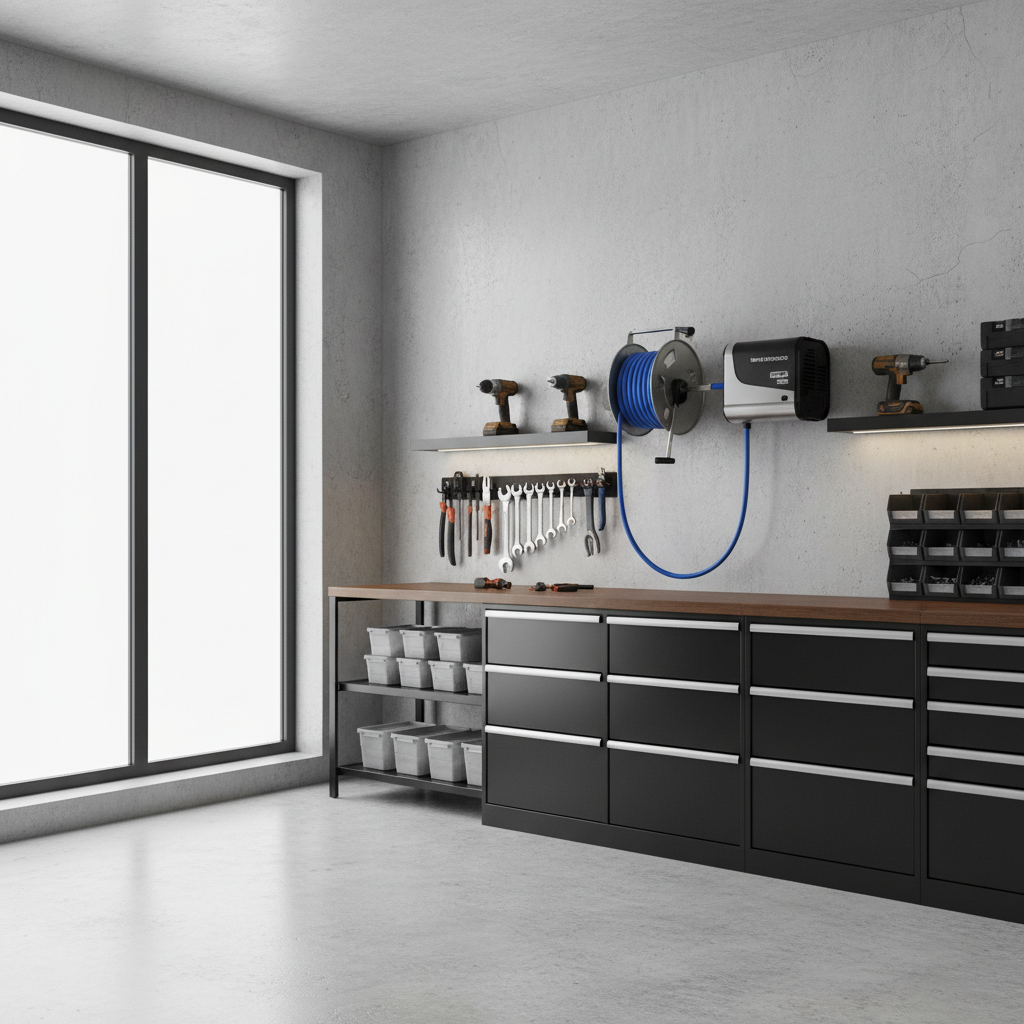
One quick note before we get into it: many “best” lists ignore installation constraints and airflow loss. Those two details decide whether your impact wrench feels snappy or sluggish, and whether your reel lasts one season or many.
What “best” really means for a garage air hose reel
In most garages, “best” comes down to reliability, safe retraction, and delivering enough air for your tools without turning the hose into a trip hazard. Here are the criteria that usually separate a solid reel from a frustrating one.
- Correct hose length: long enough to reach your farthest work spot, not so long it adds drag and clutter.
- Hose diameter (ID): common sizes are 1/4 inch and 3/8 inch. Larger ID tends to flow more air, which matters for high-demand tools.
- Working pressure and fittings: the reel should comfortably handle your compressor PSI and use common couplers so you are not stuck hunting adapters.
- Retraction style: manual rewind, spring retract, or motorized. Spring retract is popular, but the quality of the lock mechanism matters.
- Mounting flexibility: wall, ceiling, or pivot bracket. A reel mounted wrong wears faster and feels awkward.
Key takeaway: the best air hose reel for garage work is rarely “the most expensive,” it is usually “the least annoying” after 3 months of daily use.
Types of air hose reels (and who each one fits)
Most shoppers decide too early based on “retractable or not.” The better approach is to start with how you move in the space, then pick the mechanism.
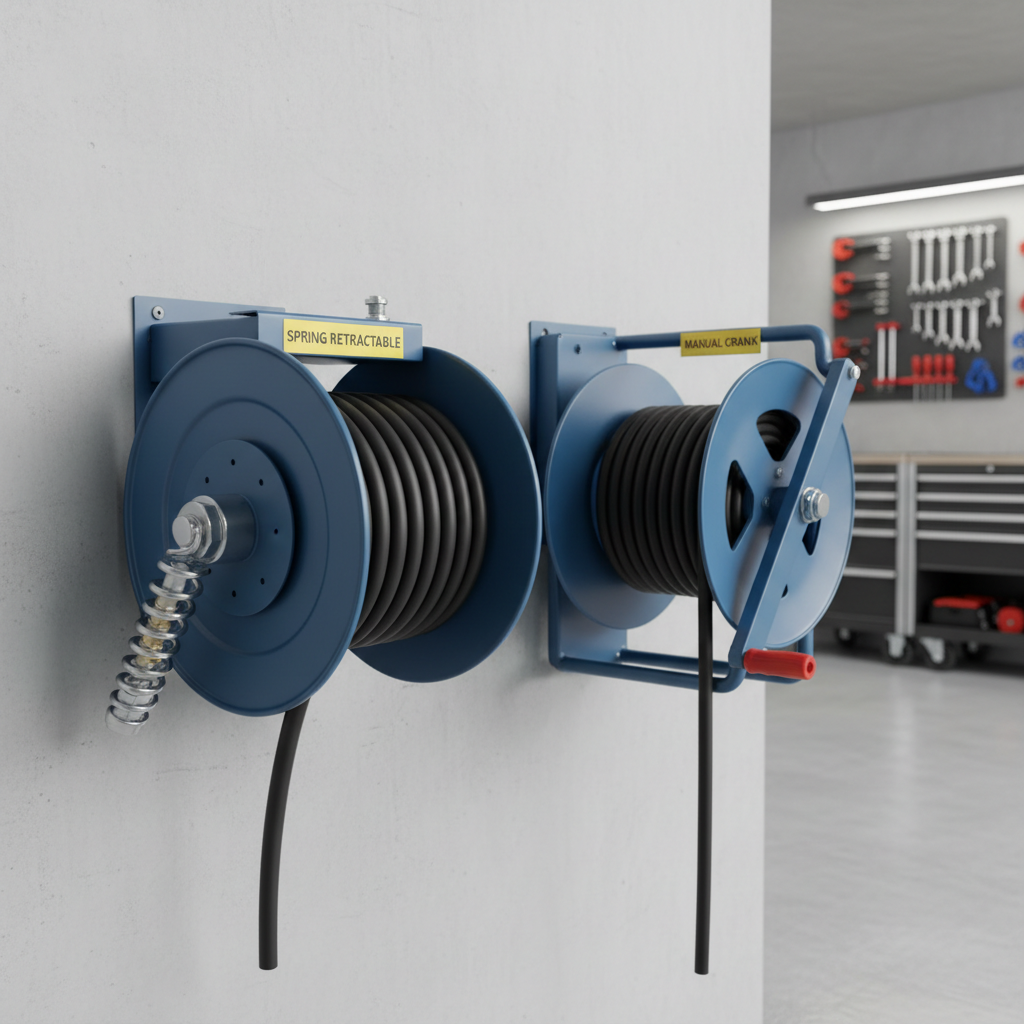
Spring retractable reels
Great for keeping the floor clear. You pull out what you need, it locks, then retracts when you are done. Look for a stable latch, controlled rewind, and a hose that resists kinking.
- Good for: general DIY, inflators, nailers, light-to-medium air tools
- Watch for: aggressive snap-back, weak lock positions, stiff hose in cold garages
Manual rewind reels
Less “fancy,” often less to break. You crank it back in, which some people actually prefer because it feels controlled. If you hate surprise recoil, this is a calmer choice.
- Good for: shared garages, occasional use, users who want simple mechanisms
- Watch for: slower cleanup, hand crank durability
Fixed storage hangers (not really a reel)
Lowest cost option, but you still handle the coil every time. Fine if you only use air once in a while and you do not mind the hose on a hook.
- Good for: very tight budgets, very low use
- Watch for: tangles, more trip risk
Quick comparison table: what to choose in 60 seconds
If you want a fast filter, use this. Then we’ll dig into specs that actually matter.
| Garage need | Recommended reel style | Suggested hose ID | Typical hose length |
|---|---|---|---|
| Inflating tires, brad nailer, light cleanup | Spring retract or manual | 1/4 in | 25–50 ft |
| Impact wrench, ratchet, die grinder (frequent) | Higher-quality spring retract | 3/8 in | 50 ft |
| Big garage, two-car bay, you move a lot | Pivotal wall/ceiling mount reel | 3/8 in (often) | 50–75 ft |
| Cold climate, stiff hose issues | Manual rewind or premium retract | 1/4–3/8 in | 25–50 ft |
Don’t overthink the length at the start. Measure the farthest point you need to reach, then add a little slack for routing around a car or workbench. Buying extra-long “just in case” often backfires with heavier pull and more pressure drop.
What specs matter most (and what usually doesn’t)
Spec sheets can look impressive while hiding the stuff that impacts daily use. Focus on these.
1) Hose inner diameter and airflow
If you run air-hungry tools, hose ID matters. A 3/8-inch hose typically supports better airflow than 1/4-inch, especially over longer runs. That can help reduce tool bogging, though your compressor and regulators still set the ceiling.
According to OSHA, compressed air use should be managed to reduce hazards, including controlling pressure and using proper equipment for the task. That same mindset applies here: match the hose and reel to the job, not the label on the box.
2) Working pressure and real-world burst claims
Most home compressors sit around 120–175 PSI max. A reel rated comfortably above your compressor’s max is the safer play. Burst pressure numbers look big, but they are not a substitute for a solid working-pressure rating.
3) Swivel fittings and seals
A good swivel reduces twisting and slows down wear. If a reel constantly “winds up” the hose, you will feel it in daily use. Small air leaks also add up as annoyance and compressor cycling.
4) Locking positions and rewind control
This is where cheap retractables get annoying. You want a lock that catches consistently and a rewind that does not slam. Controlled retraction is also a safety issue, fast snap-back can hit knuckles or damage the coupler.
5) Mounting bracket strength and pivot range
In a garage, the reel gets yanked sideways. A stout bracket and smooth pivot helps keep pulls straight, which helps the spring and the hose last longer.
Self-check: which reel fits your garage best?
Answer these quickly. If you get stuck on one question, that’s probably your deciding factor.
- How far is the farthest point you need air? Measure wall-to-driveway edge, or corner-to-corner, not just “to the car.”
- Which tools do you actually use? Nailers and inflators are forgiving, grinders and impacts are less forgiving.
- Do you hate recoil? If yes, prioritize controlled rewind or manual crank.
- Is your garage cold part of the year? Some hoses stiffen and fight retraction.
- Where can you mount it? Wall studs, ceiling joists, or masonry all change the hardware plan.
- Do you need portability? A reel is “installed,” if you move often, consider a lighter setup or quick-disconnect strategy.
Rule of thumb: if you’re unsure, aim for a reputable retractable reel with 50 ft hose and a mounting pivot, it tends to cover most home garage layouts without feeling oversized.
Installation and setup tips that prevent 80% of problems
A reel can be excellent and still feel terrible if it’s mounted wrong. This is the part most people rush.
Mounting location
- Mount near the compressor, but not so close that the hose immediately bends hard.
- Put it high enough to keep the hose off the floor, yet reachable to service fittings.
- If you work outside the garage, mount so the hose exits toward the door with minimal rubbing.
Hardware and anchoring
Use hardware that matches your surface. For studs, lag bolts into solid wood usually work well. For masonry, use anchors rated for the load. If you’re not confident, it’s reasonable to ask a handyman or contractor, a reel falling off a wall is more than a cosmetic issue.
Air line routing and a short “whip” hose
A short flexible leader hose between compressor and reel reduces vibration stress and makes alignment easier. It also helps prevent the reel inlet from acting like a rigid lever every time you pull.
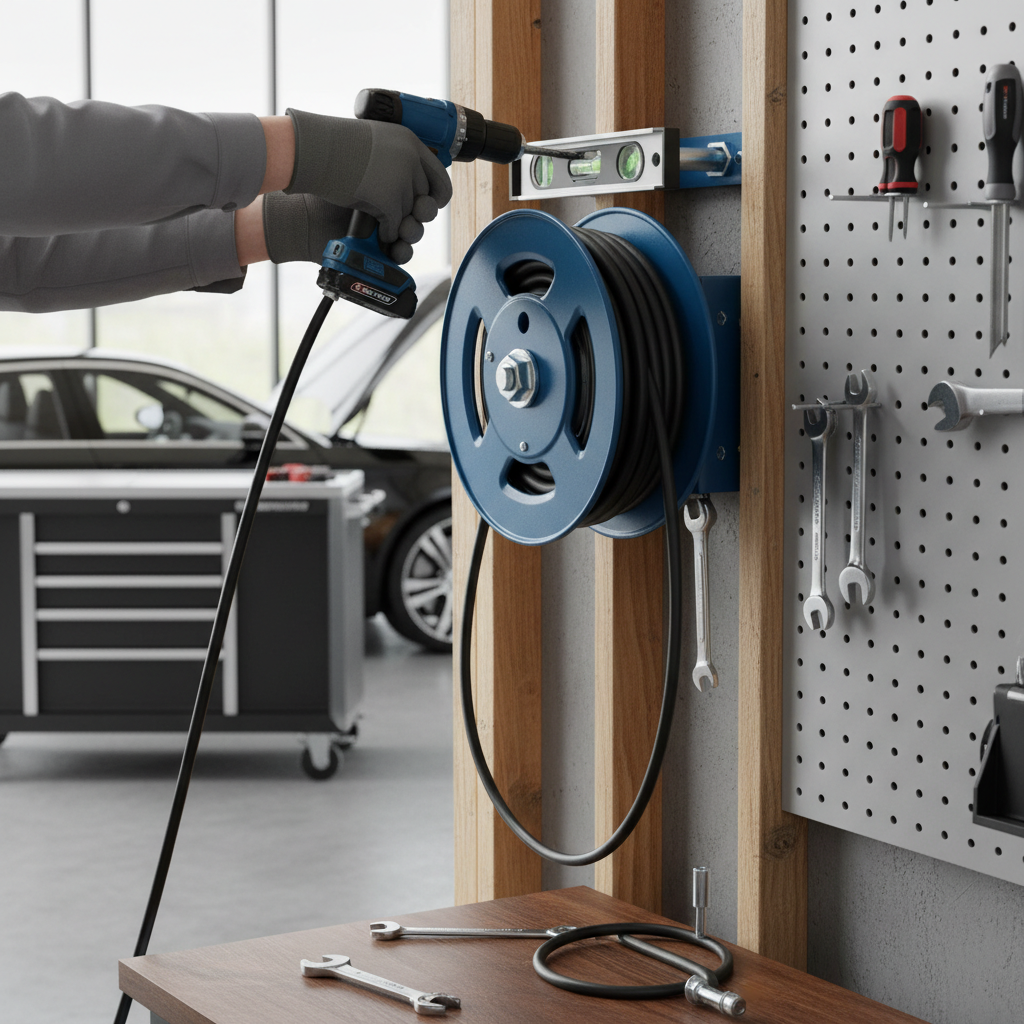
Practical tip: after mounting, pull the hose out fully once and retract it slowly, watching for rubbing points. Fix routing now, not after the hose jacket gets chewed up.
Common mistakes (and how to avoid them)
Most frustration comes from a few predictable missteps.
- Buying too long of a hose: more length often means more weight and more drag. Choose based on measurement, not anxiety.
- Ignoring hose ID: low airflow complaints often trace back to a skinny hose feeding a high-demand tool.
- Mounting into drywall: even if it “holds,” repeated pulling can loosen it. Use studs or appropriate anchors.
- Letting retractables slam: guide the hose in, don’t let it whip. It’s safer and helps the spring last.
- Skipping coupler quality: cheap couplers leak and stick, then you blame the reel. Use decent fittings and thread sealant where appropriate.
According to CPSC, injuries can happen from everyday garage tools and equipment when they are used improperly or maintained poorly. A hose reel seems harmless, but fast retraction, loose mounting, and damaged hoses can create avoidable risk.
When to consider professional help or a different setup
If you run a higher-powered compressor, use air tools daily, or plan hard piping, it can be worth asking a qualified installer. The goal is not “fancy,” it’s safe routing, correct pressure regulation, and fewer leaks.
- You see repeated hose abrasion at one spot and can’t reroute cleanly
- Your reel location requires ceiling work near electrical runs
- You want a permanent shop-style system with drops and regulators
- You notice frequent pressure issues and suspect regulator, moisture, or line sizing problems
If there’s any doubt about pressure settings or tool requirements, consult the tool manufacturer or a professional, compressed air can cause injury if misused.
Conclusion: choosing the best air hose reel for your garage in 2026
The best choice usually looks boring on paper: the right hose ID for your tools, a length that matches your space, a reel that retracts without drama, and a mount that stays solid. If you only remember one thing, measure your reach and pick the mechanism you won’t resent using.
If you want a simple next step, grab a tape measure tonight and list the tools you run most, then use the table above to narrow to one reel style and one hose size, after that, shopping gets a lot easier.
FAQ
What hose length is best for a typical two-car garage?
Many people land on 50 ft because it reaches around a vehicle and out toward the driveway without feeling excessively heavy. If your compressor sits deep in the back corner, measure first, you may need more, but longer is not automatically better.
Is a retractable reel worth it compared to a simple hook?
If you use compressed air weekly, retractable reels usually pay off in less clutter and faster cleanup. If you only inflate tires a few times a year, a hook can be perfectly fine and has fewer moving parts.
Should I choose 1/4-inch or 3/8-inch air hose for a garage reel?
For inflators and nailers, 1/4-inch is often adequate. For impact tools or anything that feels “air hungry,” 3/8-inch tends to be more forgiving, especially over longer runs.
Can I mount an air hose reel to the ceiling?
Yes, if you can anchor into joists and route the line safely. Ceiling mounts can keep the hose out of the way, but installation is less forgiving, if you’re uncertain about structure or nearby wiring, consider professional help.
Why does my reel hose keep kinking near the outlet?
Common causes include too-tight bend radius, pulling at a steep angle, or a stiff hose compound. A pivoting bracket, better routing, or a different hose material can reduce kinks.
Do air hose reels reduce PSI?
The reel itself doesn’t “steal” pressure, but the total system can lose pressure from hose length, small diameter, restrictive fittings, or leaks. If a tool feels weak, check couplers and regulators, then consider a larger ID hose.
How do I stop a retractable reel from snapping back?
Guide the hose in by hand and avoid releasing it under tension. If it still recoils aggressively, the spring may be over-tensioned or the reel may lack good rewind control, in that case, a different model or manual reel can be a better fit.
If you’re trying to pick the best air hose reel for garage use without wasting a weekend on returns, start by matching hose ID to your main tools and confirming a mounting spot you can anchor confidently, if you want, share your compressor PSI, tool list, and measured reach and I can help you narrow the spec targets.